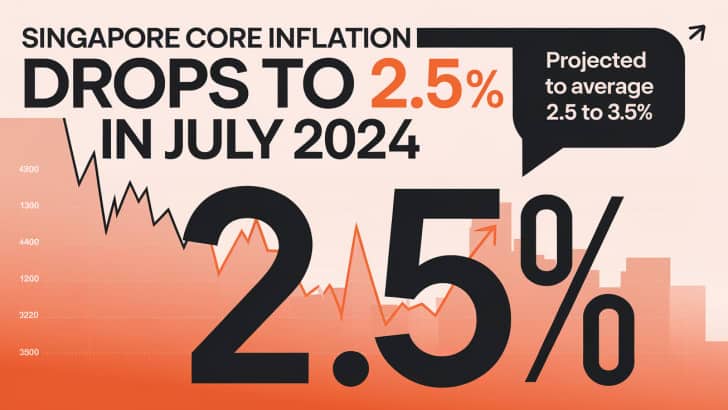
Singapore’s Core Inflation Drops to 2.5% in July 2024
Singapore's core inflation eased to 2.5% in July 2024, down from 2.9% in June, though car and taxi costs climbed while food and housing softened.
D
Daily.SG Newsroom
Archive · 23 Aug 2024
Image: Daily.SG Archive / Daily.SG
SHARE
SHARE
KEY POINTS
●Core inflation dropped to 2.5% in July 2024 from 2.9% in June, signalling a slowdown in overall price pressures
●Private transport costs swung sharply upward, rising from -0.7% in June to 0.9% in July
●Food prices and housing costs both eased slightly, providing some relief to household budgets
●The monetary authority expects core inflation to continue moderating gradually and reach between 2.5% and 3.5% for the full year 2024
●Global energy stability, steady food prices worldwide, and a stronger Singapore dollar are helping to contain inflation
IN SIMPLE TERMS
Prices in Singapore are not rising as fast as they were a few months ago. Some things, like using your own car or taking a taxi, got more expensive, but food and housing costs went down a little bit.
WHY IT MATTERS
Easing inflation suggests prices are becoming more manageable for households and may influence future monetary policy decisions.
Car owners and taxi users face higher costs, while savings on food and housing help offset the squeeze on transport budgets.
Monetary authorities warn that rapid wage growth or geopolitical shocks could push inflation higher again despite current downward momentum.
Stable inflation within the expected range supports economic planning for businesses and individuals throughout Singapore.
Core Inflation measures price changes for most things we buy, leaving out big changes in rent and car costs.
CPI-All Items measures price changes of a fixed basket of typical household goods and services over time.
Singapore’s Inflation Rates in July 2024
In July 2024, Singapore saw changes in its inflation rates.
The Monetary Authority of Singapore (MAS) and Ministry of Trade and Industry (MTI) shared this news on 23 August 2024.
Core inflation went down to 2.5% from 2.9% in June.
This means prices of everyday items went up, but not as much as before.
CPI-All Items inflation stayed the same at 2.4%.
Inflation Type
July 2024 Rate
Change from June
Core Inflation
2.5%
Decreased
CPI-All Items
2.4%
No change
Changes in Different Areas
Private transport costs went up from -0.7% in June to 0.9% in July.
This means using your own car or taking a taxi got more expensive.
Housing costs went down a bit, with rents going up only a little.
Food prices also went down slightly.
This was because non-cooked food and eating out became a bit cheaper.
What MAS Expects for the Future
MAS thinks core inflation will keep going down slowly until the end of 2024.
They predict it will be between 2.5% and 3.5% on average for 2024.
According to the report, “All in, MAS Core Inflation is expected to stay on a gradual moderating trend over the rest of the quarter and step down further in Q4 2024.”
Reasons for Changes in Inflation
Stable global energy prices
Steady food prices around the world
Stronger Singapore dollar
These factors help keep prices from going up too fast in Singapore.
Things That Could Change Inflation
The report states, “Risks to the inflation outlook remain.”
MAS warns that some things could make prices go up more than expected.
If more people get jobs and wages go up quickly, it could lead to higher prices.
Things like world problems or bad weather could also affect prices in Singapore.
What This Means for You
If you’re buying a car, it might cost more now than a few months ago.
But food and housing might not be much more expensive than before.
MAS will keep watching prices to make sure they don’t go up too fast.
They might change some rules if needed to keep prices stable.
MAS and MTI will keep checking inflation rates to help keep prices steady for everyone in Singapore.
Should the monetary authority be prepared to tighten policy if rapid wage growth threatens the inflation outlook, or should it focus on supporting employment first?
Be the first to weigh in.
👍 AGREE0 VOTES · LIVEDISAGREE 👎
D
Daily.SG Newsroom
Archive
Part of the Daily.SG editorial team. Covering Singapore news and analysis.