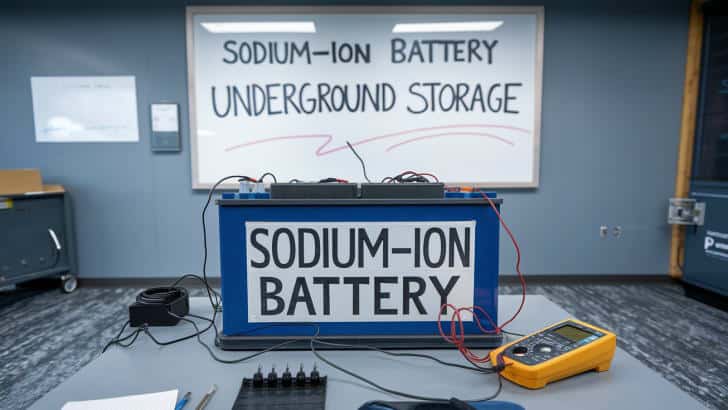
S$7.8M EMA Grant for Sodium-Ion Battery and Underground Storage Studies
Singapore awards S$7.8 million to two companies to develop cheaper and more space-efficient energy storage systems for the country's growing solar energy needs.
D
Daily.SG Newsroom
Archive · 24 Oct 2024
Image: Daily.SG Archive / Daily.SG
SHARE
SHARE
KEY POINTS
●Energy Market Authority grants S$7.8 million to two companies for energy storage innovation projects.
●Posh Electric will test sodium-ion batteries as a cheaper alternative to conventional lithium-ion batteries because sodium is more abundant.
●VFlowTech will study underground energy storage systems to minimise land use while addressing safety concerns like fire safety.
●Energy storage is critical for Singapore's solar energy expansion, as it allows the country to store power generated during the day for use when solar is unavailable.
●If successful, these projects could make energy more reliable and affordable for Singaporeans and support the country's sustainable energy goals.
IN SIMPLE TERMS
Singapore is giving money to two companies to test new ways of storing energy. One company will try cheaper batteries made from sodium instead of lithium, and the other will study how to store energy underground to save space. Better energy storage helps Singapore use more solar power, which only works during the day.
WHY IT MATTERS
Energy storage makes solar power reliable by storing daytime energy for use at night or on cloudy days.
Cheaper sodium-ion batteries could reduce the cost of energy storage and eventually lower electricity costs for consumers.
Underground storage systems help Singapore use its limited land more efficiently for energy infrastructure.
These innovations support Singapore's broader goals for sustainable and renewable energy deployment.
Singapore awards S$7.8M EMA grant for energy storage solutions.
Posh Electric to test sodium-ion batteries as cheaper alternative.
VFlowTech to study underground energy storage systems.
Singapore’s push for better energy storage takes a big leap with new grants for innovative solutions.
Key Terms Simplified
Energy Storage Systems (ESS) are devices that store energy for use later.
Sodium-ion batteries (SIBs) are batteries that use sodium instead of lithium.
Grid resilience means the power system can handle and recover from problems quickly.
S$7.8M EMA Grant in Energy Storage
On 23 October 2024, the Energy Market Authority (EMA) of Singapore made a big announcement.
They are giving out S$7.8 million to two companies.
This money will help these companies find better ways to store energy.
According to EMA, these new ways should be cheaper and take up less space.
The two companies chosen are Posh Electric and VFlowTech.
They will work on different projects to improve energy storage.
Why Energy Storage Matters
Energy storage is very important for Singapore.
It helps the country use more solar energy.
Solar energy is not always available, like at night or on cloudy days.
Energy storage systems can keep extra energy for later use.
This makes solar energy more reliable.
Mr Puah Kok Keong, Chief Executive of EMA, explained why this is important.
He said, “As Singapore expands solar deployment, energy storage systems will become more important to enhance grid resilience and ensure power system stability.”
Posh Electric’s Sodium-Ion Battery Project
Posh Electric will test a new kind of battery.
These are called sodium-ion batteries (SIBs).
They could be cheaper than the batteries we use now.
This is because sodium is more common than lithium.
As stated by EMA, “Sodium is more naturally abundant than lithium, SIBs could potentially be a cheaper alternative to conventional lithium-ion batteries.”
If successful, this could make energy storage more affordable for Singapore.
VFlowTech’s Underground Storage Study
VFlowTech has a different project.
They will study how to put energy storage systems underground.
This could save a lot of space in Singapore.
But it’s not simple.
EMA notes, “Locating ESS underground will minimise the land required, but will also require a better understanding of its safety parameters, including fire safety.”
VFlowTech will also test a mix of different battery types.
Company
Project Focus
Potential Benefit
Posh Electric
Sodium-ion batteries
Lower cost
VFlowTech
Underground storage
Space saving
Impact on Singapore’s Energy Future
These projects could change how Singapore uses energy.