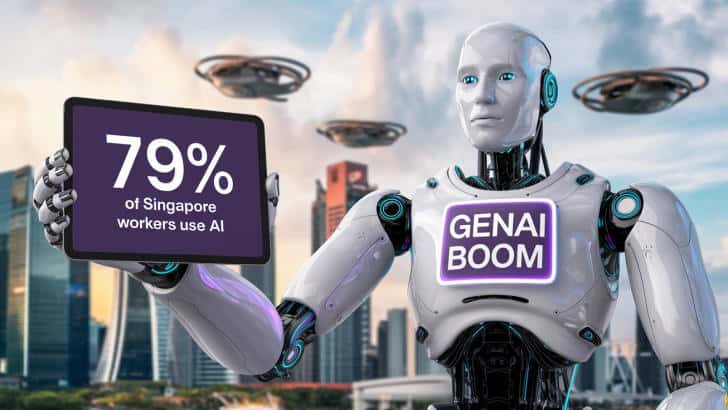
GenAI Boom: 79% of Singapore Workers Use AI at Work
Nearly four in five Singapore workers now use GenAI at work, far outpacing the global average and reshaping how employers think about flexibility, skills, and retention.
D
Daily.SG Newsroom
Archive · 30 Oct 2024
Image: Daily.SG Archive / Daily.SG
SHARE
SHARE
KEY POINTS
●GenAI use among Singapore workers jumped from 24% in 2023 to 79% in 2024, leading the global average of 75%.
●Nearly half of workers say GenAI boosts their productivity and helps them focus on meaningful tasks; employers largely agree.
●Full remote work support has plummeted from 42% to 16% among employers, but 76% now offer hybrid arrangements.
●57% of Gen Z workers think about quitting, compared to just 25% of Gen X, signalling a retention challenge amid rapid tech change.
●A gap exists between employer expectations (48% foresee major tech disruption) and worker confidence (32%), creating friction in AI adoption.
IN SIMPLE TERMS
Most workers in Singapore are already using AI tools like ChatGPT at their jobs. Bosses think it helps people work faster and focus on important things, but young workers are more likely to quit because they worry about job security and want better opportunities.
WHY IT MATTERS
Singapore's GenAI adoption rate outpaces the world, signalling the nation is rapidly reshaping its economy and workforce practices.
Young workers' high quit intent reveals employers must rethink retention strategies beyond salary, especially as automation transforms job roles.
The shift from remote to hybrid work reflects employer concerns about collaboration and culture in an AI-driven workplace, creating friction with worker preferences.
The widening skills gap and worker anxiety about relevance mean continuous upskilling is now non-negotiable for job security.
GenAI adoption in Singapore’s workplace surges to 79% in 2024.
76% of Singapore employers support hybrid work policies.
Younger generations show higher quit intent and GenAI usage.
Singapore leads in Generative AI adoption, reshaping work practices and employee expectations.
Key Terms Simplified
Generative AI (GenAI) is a computer system like ChatGPT that can create new content, like text or images.
Hybrid work means working some days at the office and some days at home.
Quit intent is when an employee thinks about leaving their job.
GenAI Transforms Singapore’s Workplace
According to EY’s latest survey, Generative AI use in Singapore workplaces has jumped to 79% in 2024.
This is higher than the global average of 75%.
It’s a big increase from 24% in 2023.
Another 9% of Singapore workers plan to use GenAI soon.
The EY Work Reimagined Survey 2024 looked at 17,350 workers and 1,595 employers in 23 countries.
Group
Generative AI Usage
Gen Z
23%
Millennials
20%
Gen X
15%
Boomers
14%
Impact of Gen AI on Work
Nearly half of Singapore workers say Generative AI helps them work better.
48% report better productivity with GenAI.
47% say it helps them focus on important tasks.
Employers agree.
74% think Gen AI boosts productivity.
70% believe it helps workers focus on high-value work.
Samir Bedi, EY Asean People Consulting Leader, said, “The speed of adoption of Gen AI has brought important workforce considerations to the forefront, from technology and skills investment to the importance of fostering an organisational culture rooted in trust and retention.”
Changing Work Arrangements
The survey shows fewer Singapore employers support full remote work.
Only 16% allow full remote work now, down from 42% last year.
But 76% of employers have hybrid work policies.
This lets workers work from home 2 to 4 days a week.
It’s up from 54% in 2023.
40% of Singapore workers want flexible work locations in new jobs
47% prioritise higher salaries when job hunting
46% report good learning and upskilling chances at work
Skills and Job Satisfaction
55% of workers think their skills will stay useful for the next 3 years.
But 58% know they need to learn new skills.
Young workers are more likely to quit their jobs.
57% of Gen Z think about leaving, compared to 25% of Gen X.
Bedi advises, “Talent leads should focus less on how long an employee stays with them and more on their values, the quality of their experience and contribution to the organization.”
Technology Expectations Gap
The survey shows a difference in how employers and workers see new tech.
48% of employers expect big changes from new tech.
But only 32% of workers think the same.
This gap needs attention for smooth AI integration at work.
Do you think GenAI will make your job easier in the next few years?