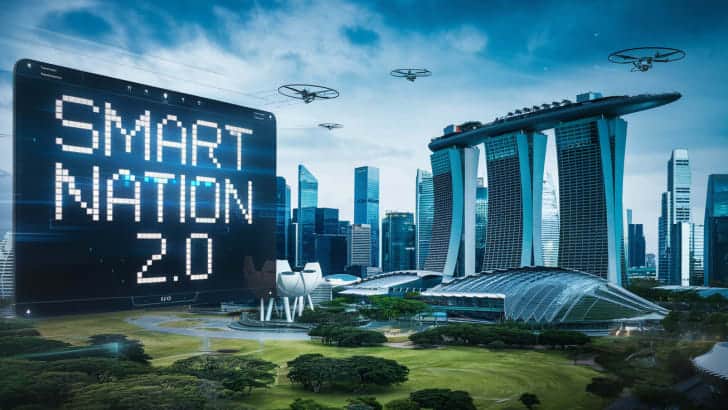
Singapore launches Smart Nation 2.0, a new phase of its decade-long digital transformation aimed at making the island a leading global city through technology.
D
Daily.SG Newsroom
Archive · 2 Oct 2024
Image: Daily.SG Archive / Daily.SG
SHARE
SHARE
KEY POINTS
●Smart Nation 2.0 was launched on 1 October 2024, marking 10 years since Singapore began its digital transformation in 2014
●Singapore has achieved major milestones including near-complete government service digitalisation and widespread adoption of cashless payments
●The government is addressing concerns such as mental health issues from social media overuse, misinformation, and cybersecurity threats
●Three main goals guide Smart Nation 2.0: growth (helping businesses and jobs), community (bringing people together), and trust (ensuring safe and fair use of technology)
●The plan emphasises AI development, youth cyber wellness education, and real-world initiatives like the Punggol Digital District
IN SIMPLE TERMS
Singapore is upgrading its plan to use technology to improve everyday life. Over the past 10 years, the country has moved towards digital services and cashless payments, and now wants to focus on three things: helping businesses grow, bringing communities together, and making sure technology is used safely and fairly.
WHY IT MATTERS
Singapore aims to leverage technology to drive economic growth and job creation across multiple industries.
The government is directly addressing online harms, misinformation, and cybersecurity risks alongside technological advancement.
Digital services are becoming the norm, affecting how residents interact with government, health services, housing, and payments daily.
Investment in AI research and youth tech education positions Singapore to compete globally and prepare workers for an AI-driven future.
Prime Minister Lawrence Wong launched Smart Nation 2.0 on 1 October 2024.
Singapore has made big steps in digital services and cashless payments since 2014.
The government is addressing concerns about technology misuse and cybersecurity.
This 2.0 launch shows how far the country has come in using tech to improve lives.
Smart Nation 2.0: A New Chapter for Singapore
On 1 October 2024, Prime Minister Lawrence Wong launched Smart Nation 2.0.
This event marks 10 years since Singapore started its SmartNation journey in 2014.
The goal is to make Singapore a top global city where people can live good lives.
According to PMO, PM Wong said, “We aimed to make Singapore one of the leading cities in the world – an outstanding place where our people can live meaningful and fulfilling lives.”
This shows how important the Smart Nation plan is for Singapore’s future.
Big Changes in 10 Years
Singapore has made big progress in digital services and cashless payments since 2014.
What was once a dream is now common in 2024.
Almost all government services are now online.
People use less cash and fewer cheques now.
New digital services include:
Parking apps
HDB flat booking
Health services
These changes make life easier for people in Singapore.
Success Stories from SmartNation
The digital plan has helped in many ways.
During COVID-19, the TraceTogether app helped with contact tracing and vaccinations.
Singapore now has over 150 AI research teams.
Young people are doing well in tech too.
For example, Jia Yu and Ze Rui won gold at an international AI contest.
The future of education in Singapore looks bright with these tech-savvy youths.
Addressing Concerns
PM Wong also talked about problems that come with more tech use.
These include mental health issues from too much social media use.
False information spreading online is another worry.
The government is working on these issues.
They are making laws to deal with online harms.
A new agency will help people affected by these problems.
Singapore is also improving its cybersecurity measures to protect against digital threats.
The Future of AI in Singapore
AI is a big part of Smart Nation 2.0.
PM Wong believes AI will change many industries.
He said, “AI is already advancing at an astonishing pace. Whatever AI we have today, it is the worst we will ever experience in our lifetime because it will just get better.”
This means workers and businesses need to keep learning to use new tech.
Smart Nation 2.0: Three Main Goals
The new Smart Nation plan has three main goals:
Goal
Meaning
Growth
Using tech to help businesses and create jobs
Community
Using tech to bring people together
Trust
Making sure tech is used safely and fairly
These goals will shape how Singapore uses tech in the coming years.
Helping Young People Use Tech Safely
The government is also focusing on helping young people use tech safely.
PM Wong said, “We must emphasise cyber wellness in schools… We are also creating more healthy online environments for our young people.”
This shows the government cares about the well-being of young tech users.
Should Singapore prioritise rapid AI and technology adoption even if it means addressing growing concerns about mental health and misinformation after the fact?
Be the first to weigh in.
👍 AGREE0 VOTES · LIVEDISAGREE 👎
D
Daily.SG Newsroom
Archive
Part of the Daily.SG editorial team. Covering Singapore news and analysis.