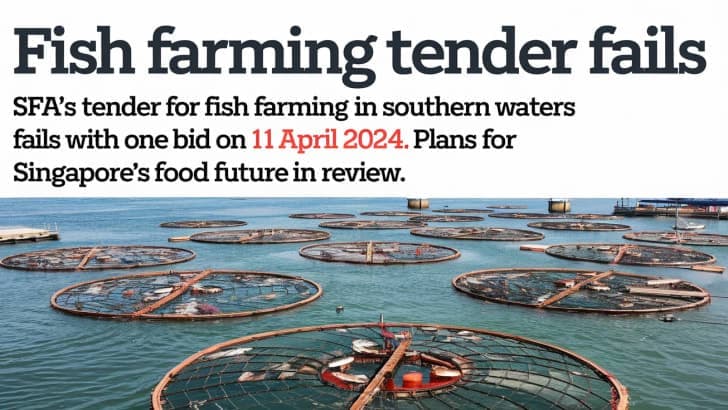
SFA Tender Fails: No Suitable Bid for Fish Farming Spaces
Singapore's bid to award sea space for fish farming drew only one unsuitable proposal, leaving two parcels off Pulau Bukom unawarded.
D
Daily.SG Newsroom
Archive · 1 Oct 2024
Image: Daily.SG Archive / Daily.SG
SHARE
SHARE
KEY POINTS
●The tender for two sea parcels off Pulau Bukom for fish farming closed on 11 April 2024 with no suitable bidder.
●Only one bid was received, but it failed to meet the required tender conditions set by the food authority.
●The failed tender may delay Singapore's goal to produce 30% of its nutritional needs locally by 2030.
●Possible barriers to bidding include strict regulations, high setup costs, and lack of modern aquaculture expertise.
●The authority will review its plans for the sea spaces with stakeholders and may need to adjust conditions or offer support to attract operators.
IN SIMPLE TERMS
Singapore put out tenders for two areas of sea where companies could farm fish to help the country grow more of its own food. Only one company applied, but their plan didn't meet the government's standards, so nobody got the contract. The government says it will keep trying to figure out how to use those sea spaces.
WHY IT MATTERS
Local fish farming is essential to Singapore's food security strategy and reducing reliance on imports.
A failed tender signals challenges in the aquaculture sector that may slow progress toward domestic food production targets.
The authority's strict standards show a commitment to quality and safety, but may also deter bidders from entering the market.
Future success may depend on balancing regulatory requirements with practical business incentives for fish farm operators.
SFA closed tender for two sea space parcels for fish farming on 11 April 2024.
Only one bid was received, which did not meet required conditions.
SFA will review plans for the sea spaces with stakeholders.
Singapore’s attempt to boost fish farming hits a snag as tender for sea spaces goes unawarded.
Singapore’s Fish Farming Plans Face Setback
On 11 April 2024, the Singapore Food Agency (SFA) closed a tender for two sea space parcels.
These spaces were meant for food fish farming.
The tender opened on 18 January 2024.
It was part of Singapore’s plan to boost local food production.
The sea spaces are located off Pulau Bukom in Singapore’s Southern Waters.
Tender Details
Information
Opening Date
18 January 2024
Closing Date
11 April 2024
Location
Off Pulau Bukom, Southern Waters
Purpose
Food Fish Farming
Lone Bidder Fails to Meet Requirements
SFA received only one bid during the tender process.
The bid came from a company called Loners Sdn Bhd.
However, their proposal did not meet SFA’s tender conditions.
As a result, SFA did not award the tender to anyone.
This decision highlights the strict standards set for farming fish in Singapore.
Implications for Singapore’s Aquaculture Sector
The failed tender raises questions about Singapore’s fish farming plans.
It shows possible challenges in the local aquaculture industry.
The lack of suitable bids might delay the development of new fish farms.
This could affect Singapore’s goal to produce more food locally.
Singapore aims to produce 30% of its nutritional needs by 2030, as part of its efforts to boost food security.
Possible reasons for the tender failure:
Strict regulations
High costs of setting up fish farms
Lack of expertise in modern aqua farming techniques
SFA’s Response and Future Plans
According to SFA, “The proposal by the sole bidder did not meet the required tender conditions.”
This statement shows SFA’s commitment to maintaining high standards in fish farming.
SFA also said, “SFA, together with relevant stakeholders, will continue to review our plans for the sea spaces.”
This indicates that SFA is not giving up on its aqua farming plans.
They will work with industry experts to find better ways to use these sea spaces.
Impact on Singapore’s Food Security Goals
Singapore aims to produce more food locally to reduce reliance on imports.
Fish farming is a key part of this plan.
The failed tender might slow down progress towards this goal.
However, it also shows SFA’s commitment to sustainability, quality and safety in food production.
This aligns with Singapore’s focus on regulatory compliance in various sectors.
Aspect
Impact of Failed Tender
Food Security
Potential delay in increasing local fish production
Industry Growth
Possible slowdown in aquaculture sector development
Quality Standards
Maintained high standards for aqua farming operations
Future Planning
Need for review and possible adjustment of tender conditions
Looking Ahead: Singapore’s Fish Farming Future
Despite this setback, Singapore’s push for local food production continues.
SFA may need to review its tender conditions to attract more bidders.
They might also need to provide more support to potential fish farm operators.
This could include training programs or financial incentives.
The goal is to balance high standards with feasible business opportunities.
Singapore’s journey to boost local fish farming faces challenges, but the government remains committed to finding solutions for a sustainable food future.
Should the food authority relax some tender conditions to attract more bidders, or maintain strict standards even if it delays local fish farming development?
Be the first to weigh in.
👍 AGREE0 VOTES · LIVEDISAGREE 👎
D
Daily.SG Newsroom
Archive
Part of the Daily.SG editorial team. Covering Singapore news and analysis.