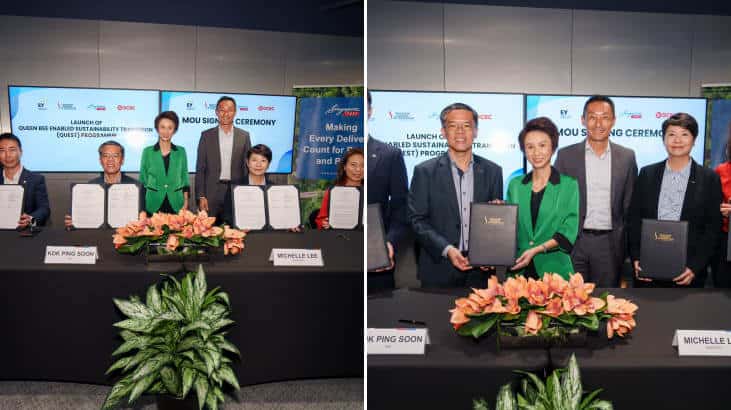
QUEST Programme Helps SingPost and 25 SMEs Go Green!
A new QUEST programme launches to help SingPost and 25 small suppliers meet incoming climate reporting rules and go green.
D
Daily.SG Newsroom
Archive · 21 Oct 2024
Image: Daily.SG Archive / Daily.SG
SHARE
SHARE
KEY POINTS
●QUEST (Queen Bee Enabled Sustainability Transition) launched on 18 October 2024 to help SMEs become more environmentally friendly and meet upcoming climate reporting requirements.
●From 1 January 2025, listed companies must report climate impact; from 1 January 2027, large non-listed companies must do the same.
●The programme, backed by the Singapore Business Federation, EY, and OCBC Bank, offers expert-led workshops on measuring carbon emissions, reducing them, and meeting environmental rules.
●SingPost has changed its supplier selection criteria to require environmental responsibility, creating pressure on SMEs to adopt sustainable practices.
●Small companies face challenges in funding and knowledge but also gain opportunities to win business from sustainability-conscious larger firms.
IN SIMPLE TERMS
Singapore is introducing new rules that require companies to report how much they pollute, starting next year. A new programme called QUEST is helping small businesses learn how to measure their emissions, cut them down, and meet these new rules so they can keep doing business with bigger companies.
WHY IT MATTERS
New climate reporting rules take effect for listed companies in January 2025, forcing SMEs to act quickly or risk losing contracts.
The programme directly addresses the knowledge and resource gap that prevents small businesses from adopting sustainable practices.
Going green is no longer optional—big companies now prioritise suppliers who demonstrate environmental responsibility, affecting SME competitiveness.
Financial and advisory support from the banking sector helps make sustainability transitions affordable and achievable for resource-constrained small firms.
New QUEST programme launched to support SingPost and SME suppliers in sustainability efforts.
Programme aims to bridge gap between large companies’ sustainability expectations and SME expertise.
Collaboration involves SBF, SingPost, EY, and OCBC Bank to empower SMEs in sustainability practices.
Singapore’s logistics sector takes a big step towards sustainability with a new programme to help small businesses go green.
New Programme to Help Small Businesses Go Green
According to SingPost, a new programme called QUEST was launched on 18 October 2024.
QUEST stands for Queen Bee Enabled Sustainability Transition.
The programme will help Singapore Post (SingPost) and its small & med-sized suppliers become more eco-friendly.
SingPost is the first logistics company to join this programme.
About 25 small companies that work with SingPost will take part at first.
Why is This Important?
Starting 1 January 2025, all listed companies in Singapore must report how they affect the climate.
Big non-listed companies must do this from 1 January 2027.
Many small companies don’t know how to do this yet.
The QUEST programme will teach them how.
Date
Requirement
1 January 2025
Listed companies must report climate impact
1 January 2027
Large non-listed companies must report climate impact
Who is Behind This Programme?
The Singapore Business Federation (SBF) started this programme.
They are working with Ernst & Young LLP (EY) and OCBC Bank.
These groups signed an agreement at SingPost Centre.
Ms Low Yen Ling, a Senior Minister of State, watched them sign.
What Will the Programme Do?
The QUEST programme will offer workshops led by experts.
These workshops will teach small companies how to:
Measure their carbon emissions
Find ways to reduce these emissions
Meet new environmental rules
SingPost has also changed its rules for choosing suppliers.
Now, suppliers must show they care about the environment too.
What People Are Saying
Mr Kok Ping Soon, CEO of SBF, said, “SBF is dedicated to adopt a proactive approach to empower SMEs in elevating their sustainability efforts and enhancing their market competitiveness.”
This means SBF wants to help small companies become more eco-friendly and competitive.
Ms Michelle Lee from SingPost said, “Embracing these practices is crucial for SMEs to maintain their long-term viability and competitiveness in an increasingly sustainability conscious business landscape.”
She believes small companies need to go green to stay in business long-term.
How OCBC Bank Will Help
OCBC Bank will provide money and advice to help small companies go green.
Mr Tan Teck Long from OCBC said, “We are committed to support SMEs with innovative financial solutions and suitable advisory services that help them drive sustainable development in Singapore and the region.”
This means OCBC will help small companies find ways to pay for green changes.
The bank’s support is similar to how it helps young people learn about money through special accounts.
Challenges and Opportunities
Some small companies might find it hard to meet new environmental rules.
They may not have the knowledge or money to make big changes quickly.
But going green can also help small companies win more business.
Big companies now want to work with suppliers who care about the environment.