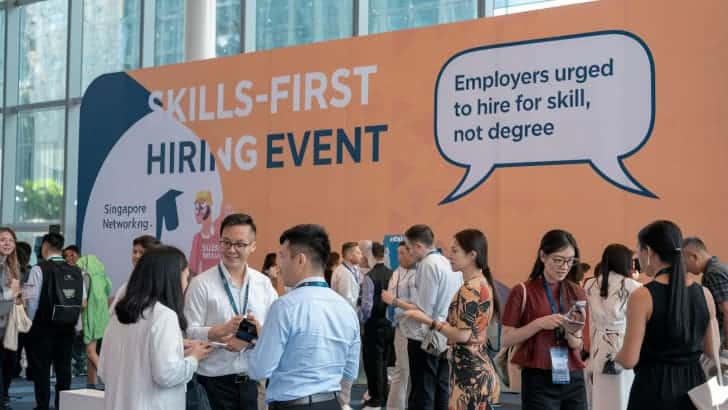
Skills-First Hiring: Employers Urged to Hire for Skill, Not Degree
Singapore launches a new plan urging employers to hire workers based on skills rather than degrees, as the country tackles an ageing workforce and talent shortage.
D
Daily.SG Newsroom
Archive · 10 Oct 2024
Image: Daily.SG Archive / Daily.SG
SHARE
SHARE
KEY POINTS
●The Alliance for Action released 8 recommendations to widen access to talent and improve hiring practices
●Skills-first hiring—prioritising ability over formal qualifications—is the central focus of the new plan
●The government is developing a skills database and standardised assessment tests to help employers identify talent from diverse backgrounds
●Companies are encouraged to offer continuous skill development and internal career pathways to retain workers
●Small and medium enterprises will receive more support through HR advisory services and technology solutions
IN SIMPLE TERMS
Singapore's government has come up with a new plan to help businesses find and keep good workers. Instead of only looking for people with fancy degrees, companies are being asked to focus on what skills people actually have. This is meant to help Singapore have enough workers to keep growing, even as the population gets older.
WHY IT MATTERS
Skills-based hiring could unlock talent from people without traditional degrees, expanding the available workforce pool in a shrinking labour market.
Workers may gain more opportunities to move between roles and upskill within their companies, improving career mobility and job security.
Businesses, especially small firms, will have clearer tools and support to assess and develop talent, potentially improving productivity and competitiveness.
The shift challenges traditional hiring norms and could reshape how employers view qualifications versus demonstrated capability in the market.
Singapore launches new Alliance for Action plan to widen access to talent.
The plan consists of 8 recommendations aimed to increase talent competitiveness.
Skills-first hiring and development practices are key focus areas.
Singapore takes bold steps to tackle workforce challenges with new talent initiative.
Singapore’s New Approach to Talent Management
On 10 Oct 2024, Singapore unveiled a new plan to solve its workforce problems.
The plan was announced at the People Behind People Forum 2024.
The new plan is made up of 8 recommendations by Alliance for Action (AfA) on Widening Access to Talent.
It aims to help Singapore stay competitive in getting and keeping talented workers.
Why Singapore Needs This Plan
Singapore faces a big challenge: its workforce is getting older.
This means there are fewer workers available for jobs.
The AfA was set up in January 2024 to find ways to fix this problem.
It looks for solutions that come from businesses, not just the government.
According to MOM, Dr Bicky Bhangu, a co-lead of the AfA, said, “A productive and agile workforce is pivotal in driving business growth.”
What the AfA Did
The Alliance for Action ran tests in different industries for nine months.
They wanted to find out what problems employers face when hiring people.
They also tested ways to solve these problems.
After all this work, they came up with four main areas to focus on:
Hiring people based on their skills, not just their qualifications
Helping workers learn new skills to move to different jobs in the same company
Changing jobs to make them easier for different types of people to do
Helping small companies get better at managing their workers
The AfA’s Recommendations
The Alliance for Action came up with eight suggestions to help Singapore get and keep talented workers.
AfA’s Recommendation
Responses from MOM, SNEF, and Ecosystem Partners
#1: Encourage adoption of a National Skills Taxonomy and to develop a database with verified skills of the workforce to enable skills-first hiring.
MOM is supportive. Under Career Health SG, the Government is developing initiatives to provide individuals and employers with better skills data to support skills-first hiring and development.
#2: Develop sector or job-specific standardised assessment tests for skills-heavy jobs to help employers assess transferable skills of candidates from different backgrounds.
SNEF is supportive. SGTech and SMF will develop this for their respective sectors in partnership with SNEF.
#3: Develop playbooks and identify off-the-shelf HR tech solutions to guide and simplify implementation of internal marketplace solutions.
MOM is supportive. IHRP will work with the industry to develop playbooks. MOM will also work with relevant agencies to support SMEs with suitable HR tech solutions.
#4: Build a ‘talent co-development’ model where employers collaborate to aggregate talent development opportunities.
SNEF will work with SMF to design a pilot. The initiative will start with skills-heavy sectors where talent retention is critical, e.g., Manufacturing.
#5: Enable employers to provide career guidance and planning to their workers for career and skills development.
SNEF is supportive. As the Jobs-Skills Integrator for Retail (JSIT-R), SNEF has incorporated structured career planning workshops and will expand to more sectors. NTUC and affiliated unions will also support companies through Company Training Committees (CTC).
#6: Develop structured programmes to attract students, seniors, and stay-at-home mothers to take up hard-to-fill jobs.
SNEF and SRA will design a structured traineeship program for students in retail frontline jobs, with plans to expand for seniors and stay-at-home mothers. NTUC will support scaling up through job matching and career advisory services.
#7: Increase access of SMEs to HR advisory and consultancy services to improve employers’ skills-first hiring and workforce development capabilities.
MOM is supportive. Employers can use the NTUC CTC grant to access HR advisory services. MOM and IHRP will pilot “CHRO-as-a-Service” for accessible HR advisory through certified HR experts or technology solutions.
#8: Stronger industry push for HR to level up through IHRP certification, which provides employers access to external support and resources from the certified HR community.
SNEF is supportive and will work with TACs to encourage HR professionals to obtain their IHRP certification.
These suggestions aim to solve the problem of not having enough workers.
They also want to make Singapore’s workforce more competitive.
Ms Aileen Tan, another co-lead of the AfA, emphasised, “HR plays a pivotal role in setting the stage within our organisations to enable the adoption of skills-first practices.”
This shows how important it is for companies to change how they hire and train workers.
What This Means for Employers
The AfA is part of a bigger plan called Career Health SG.
This plan aims to make the most of Singapore’s talented workers.
Employers are asked to start hiring based on skills, not just qualifications.
They are also encouraged to help their workers learn new skills.
Old Way
New Way
Hiring based on degrees
Hiring based on skills
Fixed job roles
Flexible job designs
Limited training
Continuous skill development
Possible Challenges for Skills-First Hiring
Not everyone agrees on how well these new ideas will work.
Some industries still prefer to hire based on formal qualifications.
There might be debates about how much experience matters compared to qualifications.
The new recommendations aim to make all industries more productive.
They should help businesses grow even when there aren’t many workers available.
If these changes work, Singapore’s workforce could become more flexible and competitive.
Mr Zaqy Mohamad, Senior Minister of State for Manpower, stated, “MOM and SNEF call on all employers to adopt skills-first hiring and workforce development practices to increase talent competitiveness.”
This shows that the government is serious about making these changes happen.