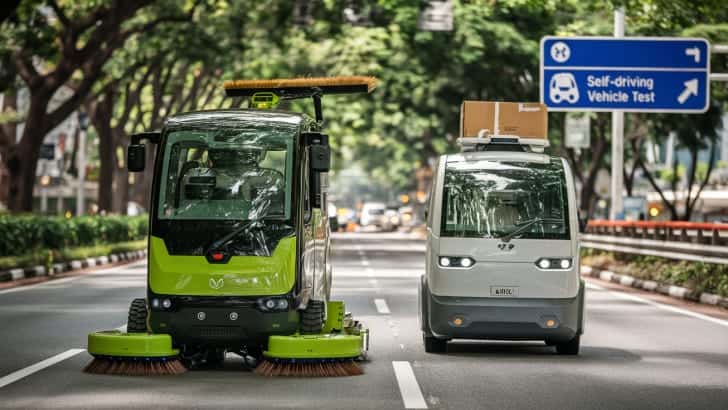
LTA Approves 2 Self-Driving Vehicle Tests for Singapore Roads
Singapore approves two self-driving vehicle tests on public roads—robo-sweepers and goods-moving vans—to tackle worker shortages in logistics and transport.
D
Daily.SG Newsroom
Archive · 6 Nov 2024
Image: Daily.SG Archive / Daily.SG
SHARE
SHARE
KEY POINTS
●The Land Transport Authority has approved two self-driving vehicle tests: robo-sweepers on Airline Road and Marina Coastal Drive, and electric goods vehicles between distribution centres.
●Self-driving minibuses will initially run on quiet routes with less traffic, with a safety driver on board during early tests.
●All vehicles must be tested in a circuit before road use and will be checked to perform safely in local conditions like heavy rain.
●Singapore started exploring self-driving technology in 2015 and is now expanding the initiative to address manpower challenges in logistics and public transport.
●The transport authority is open to collaborating with other companies interested in deploying self-driving vehicles.
IN SIMPLE TERMS
Singapore is testing two types of self-driving vehicles on real roads: one that sweeps streets on its own, and another that moves goods between warehouses. The government hopes these vehicles will help solve the shortage of workers in transport and delivery jobs.
WHY IT MATTERS
Self-driving vehicles could ease Singapore's pressing worker shortage in logistics and public transport sectors.
Approving road tests signals Singapore's commitment to modernising its transport system with autonomous technology.
Rigorous testing and safety protocols ensure vehicles perform reliably in Singapore's local conditions before wider deployment.
The rollout could eventually make transport more efficient and help address long-standing operational challenges in the sector.
In a recent article by The Straits Times, Singapore’s plan to use self-driving minibuses and goods vehicles was revealed.
Transport Minister Chee Hong Tat shared this news at a big transport event on 6 Nov 2024.
The event is the Singapore International Transport Congress and Exhibition.
Over 5,000 transport professionals attended this event.
The Land Transport Authority (LTA) has given the green light for self-driving vehicles to be used in 2 cases.
First is electric robo-sweepers use on Airline Road and Marina Coastal Drive.
Next is electric logistics vehicles use to transfer goods between Fairprice’s distribution centres in Benoi and Joo Koon.
Benefits of Self-Driving Vehicles
According to The Straits Times, Chee Hong Tat said, “These use cases can help address our pressing manpower challenges in the logistics and public transport sectors.”
Self-driving vehicles can help solve worker shortages in moving goods and public transport.
The focus is on minibuses and goods vehicles because they can easily follow fixed routes.
LTA’s Plans for Self-Driving Minibuses
The LTA plans to buy some self-driving minibuses.
They will work with a public bus company to use these buses.
At first, these buses will run on quieter routes with less traffic.
A safety driver will be on the bus during early tests.
Later, someone might control the bus from far away.
Vehicle Type
Initial Use
Safety Measure
Goods vehicles
Between distribution centres
Approved for specific roads
Robo-sweeping vehicles
Covering 2 areas
Approved for specific roads
Self-driving minibuses
Quiet routes with less traffic
Safety driver on board
Safety and Testing
The LTA has revised rules for testing and assessing self-driving vehicles.
These vehicles must be tested in a circuit before they can be used in Singapore roads.
The LTA will check how well these vehicles work in local conditions, like heavy rain.
They know that accidents might still happen, just like with human drivers.