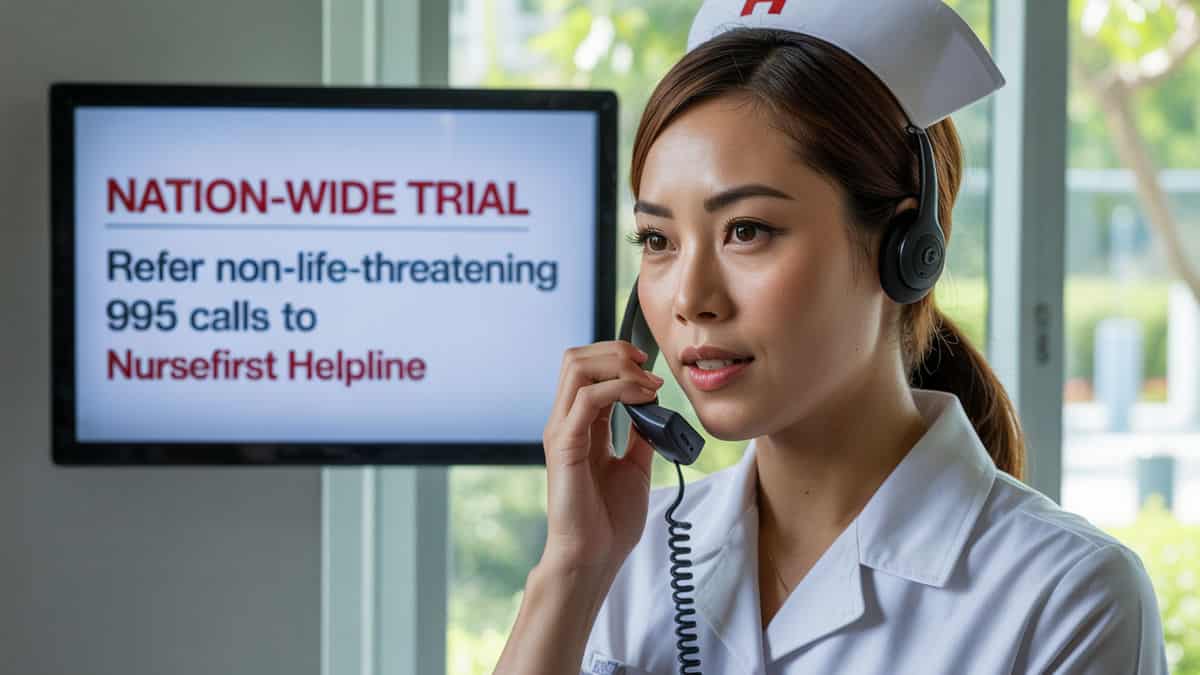
National Trial Redirects Non-Life-Threatening 995 Calls to Save Lives
Singapore will start a nation-wide trial from 1 June 2025 to redirect non-life-threatening 995 calls to trained nurses, freeing up ambulances for real emergencies.
D
Daily.SG Newsroom
Archive · 30 May 2025
Image: Daily.SG Archive / Daily.SG
SHARE
SHARE
KEY POINTS
●A six-month nation-wide trial starting 1 June 2025 will redirect non-life-threatening 995 calls to the NurseFirst helpline, run by trained nurses with emergency doctor support.
●SCDF received 245,279 Emergency Medical Services calls in 2024—a 57% increase from 2014—making the redirection necessary to prioritise life-threatening cases.
●The public can also call NurseFirst directly at 62626262 (8:00am to 11:00pm daily) for free medical advice on non-urgent issues without calling 995.
●The Advanced Medical Protocol System will assess each 995 call to decide if it is life-threatening; if not, the call transfers to NurseFirst with patient details shared.
●Examples of non-life-threatening cases likely to be referred include mild colds, minor sprains, small cuts, nosebleeds, and minor allergic reactions.
IN SIMPLE TERMS
When you call 995 for something that is not a life-or-death emergency, instead of sending an ambulance, the call centre will connect you to a trained nurse at NurseFirst who can give you medical advice over the phone. This way, ambulances can focus on people who really need them urgently.
WHY IT MATTERS
Faster response times for genuine emergencies like cardiac arrest and severe breathing difficulties when ambulances are not delayed by minor cases.
Ageing population and rising health needs mean EMS demand is climbing; this trial is a way to manage growing pressure on Emergency Departments and ambulance services.
Free medical advice from trained nurses helps people make better decisions about whether they need an ambulance or can manage their condition differently.
Several developed countries (UK, Japan, Denmark, Finland) already use similar healthcare helpline models, so this approach is proven elsewhere.
Singapore will start a nation-wide trial on 1 June 2025 to refer non-life-threatening 995 calls to the NurseFirst helpline.
The trial aims to ease demand on ambulances and Emergency Departments so that life-threatening cases get help faster.
The public can call NurseFirst at 62626262 for free medical advice on non-urgent issues from 8:00am to 11:00pm daily.
Singapore is changing how it handles non-life-threatening 995 calls by using trained nurses to guide patients and free up ambulances for real emergencies.
In a press release by MOH, Singapore will start a nation-wide trial on 1 June 2025 to refer some 995 calls to a medical triage helpline called NurseFirst.
This trial is a pilot run by Singapore Civil Defence Force (SCDF) and Woodlands Health (WH).
SCDF answers most ambulance calls in Singapore by using the 995 emergency number.
This change directs people with non-life-threatening issues to trained nurses who give real-time medical advice and suggest suitable care options through an effective medical triage system.
According to MOH, “From 1 June 2025, the Singapore Civil Defence Force (SCDF) and Woodlands Health (WH) will pilot a nation-wide trial to refer non-life-threatening 995 calls to a medical triage helpline.”
The move forms part of Singapore’s plan to prioritise timely emergency response and keep ambulances for those most in need.
Why Is the Trial Needed? Growing EMS Demand
Demand for Emergency Medical Services (EMS) is rising fast.
In 2024, SCDF received 245,279 EMS calls.
This means there were about 672 calls every day.
That is a 57% increase from 2014.
More calls are expected because Singapore’s population is ageing and health needs are increasing.
SCDF and hospitals can focus resources on life-threatening emergencies
Cardiac arrest and severe breathing troubles get priority
Other countries like the UK, Japan, Denmark, and Finland use similar healthcare helpline models
As quoted in MOH, “This will enable SCDF to reduce conveyances to EDs, and focus SCDF and hospitals’ resources on life-threatening cases, such as patients experiencing cardiac arrest or severe breathing difficulties.”
MHA and MOH back the trial in Singapore.
About the NurseFirst Helpline
Woodlands Health (WH) runs the NurseFirst helpline.
NurseFirst is staffed by trained nurses and has emergency doctor support.
The first pilot started in the Northern district on 4 February 2022.
The new pilot expands nurse support to all of Singapore.
Nurses use a medical triage system to assess callers’ symptoms.
They suggest the best step, such as seeing a GP nearby, managing at home, or using a non-emergency ambulance.
Open 8:00am – 11:00pm daily
Callers get the advice for free
The public can call 62626262 directly at any time during opening hours
According to MOH, “The public is also encouraged to call the NurseFirst helpline directly at 62626262 for non-life-threatening medical conditions, to receive timely medical advice at no cost.”
How Will 995 Referrals Work?
All 995 medical calls go first to SCDF’s Operations Centre.
Call-takers use the Advanced Medical Protocol System to check how serious the case is.
The system asks about consciousness, breathing, and symptoms to decide if it’s an emergency.
If the call is non-life-threatening, the call is transferred to NurseFirst
Key patient details are shared before the transfer to keep things smooth
If things get worse while talking to NurseFirst, SCDF sends an ambulance immediately
Outside 8:00am to 11:00pm, SCDF will follow their normal rules for non-urgent 995 cases
The nurse will give advice and can suggest other care like calling 1777 for a non-urgent ambulance or visiting a doctor.
When Should I Call 995 in Singapore?
Use 995 only for real emergencies.
Examples:
Cardiac arrest
Severe breathing difficulties
Major injuries or accidents
If your case is minor (see below), you can call NurseFirst at 62626262 or visit a nearby GP or 24-hour clinic.
How Long Will the Trial Last?
This pilot will run for six months from 1 June 2025.
SCDF and WH will track the results and review if it should continue after that.
The trial will check if using the healthcare helpline helps save ambulances for important cases and reduces strain on Emergency Departments.
Past Actions to Manage EMS Demand
Singapore has done a lot to control rising ambulance demand before this NurseFirst helpline trial.
Date
Initiative
June 2009
SCDF used Private Ambulance Operators, adding more EMS ambulances.
April 2013
EMT scheme began – fire and rescue staff trained as Emergency Medical Technicians.
April 2017
EMS Tiered Response Framework – matches team and speed to the emergency.
More EMTs and new CPR methods for life-threatening cases.
April 2019
Non-Conveyance Policy: Paramedics may not bring non-emergencies to hospital.
March 2023
Non-Dispatch Policy: Ambulances are not sent for non-emergencies.
July 2024
Longer wait times (up to 20 minutes) for non-urgent calls so resources focus on real emergencies.
What Counts as a Non-Life-Threatening Condition?
Here are some cases likely to be referred to NurseFirst:
Mild cold and flu symptoms
Minor strains, sprains, or limb pain
Cuts with no active bleeding
Nosebleeds or minor headaches
Mild diarrhoea or vomiting
Minor allergic reactions
Animal bites without allergic signs or heavy bleeding
Choking episodes with no more symptoms
Burns covering less than 15% of the body
Minor eye troubles (red eye, irritation)
This list is not full, but real emergencies should still go to 995.
Key Quotes from MOH
From 1 June 2025, the Singapore Civil Defence Force (SCDF) and Woodlands Health (WH) will pilot a nation-wide trial to refer non-life-threatening 995 calls to a medical triage helpline.
This will enable SCDF to reduce conveyances to EDs, and focus SCDF and hospitals’ resources on life-threatening cases, such as patients experiencing cardiac arrest or severe breathing difficulties.
The public is also encouraged to call the NurseFirst helpline directly at 62626262 for non-life-threatening medical conditions, to receive timely medical advice at no cost.
Do you agree that referring non-life-threatening 995 calls to a nurse helpline is a good way to save ambulances for real emergencies?