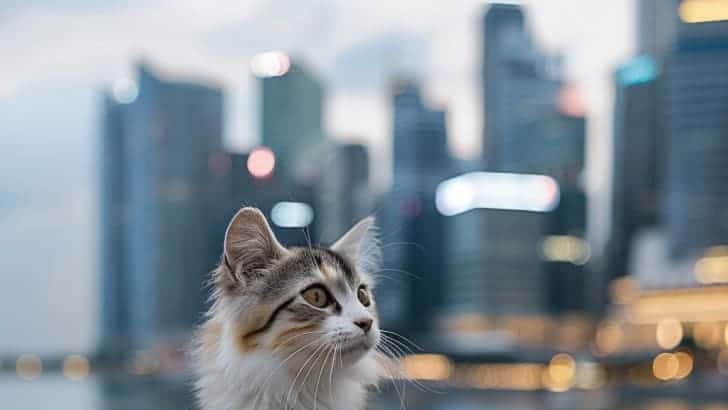
Singapore is launching a cat licensing scheme from September 2024, requiring all cats to be licensed and microchipped, with free registration during a two-year transition period.
D
Daily.SG Newsroom
Archive · 11 May 2024
Image: Daily.SG Archive / Daily.SG
SHARE
SHARE
KEY POINTS
●Cat licensing begins 1 September 2024; free registration runs until 31 August 2026.
●HDB residents may keep up to two cats; private residence owners up to three cats, all must be licensed and microchipped.
●Licenses for sterilised cats issued during transition are lifetime valid; unsterilised cat licenses expire when transition ends.
●After the transition period, unlicensed cats incur fines up to $5,000.
●Government will subsidise sterilisation for lower-income cat owners; sterilisation may become mandatory if uptake is insufficient.
IN SIMPLE TERMS
Starting September 2024, cat owners in Singapore will need to register and microchip their cats. For the first two years, registration is free, but after that, owners will face fines up to $5,000 if their cats aren't licensed. The goal is to keep cats safe, reduce unwanted breeding, and make pet ownership more responsible.
WHY IT MATTERS
Licensing and microchipping help locate lost cats and ensure they are traceable to their owners.
Government-supported sterilisation reduces unwanted breeding and overpopulation of stray cats.
Clear rules on cat limits per household (two for HDB, three for private homes) manage neighbourhood concerns and coexistence.
The two-year free registration window gives owners time to adjust to the new system without immediate financial burden.
A new era begins for feline friends and their owners in Singapore with cat licensing, promising safer and more responsible pet ownership.
Register Your Cat, Be a Responsible Owner
The Straits Times reports that a new Cat Management Framework will be put in place this September.
Up to two cats can be kept in each HDB flat, and three cats for each private residence.
Each cat must be licensed and microchipped.
Transition period starts from 1 September 2024, and ends on 31 August 2026.
During this time, cat owners can license their pets for free.
The need to license and microchip is to make sure every cat is safe and can be found if lost.
Here’s what cat owners need to know:
Licenses issued during the transition period have lifetime validity for sterilised cats.
For unsterilised cats, these licenses will be valid only during the transition period.
It will be an offence to keep unlicensed pet cats from 1 Sept 2026, with cat owners subject to fines of up to $5,000.
Cat Licensing Help for Cats and Owners
The government will also support cat sterilisation for people with less money.
These efforts will help stop cats from having too many kittens.
“Licensing will subsequently cost $15 for a one-year licence for a sterilised cat and $90 for an unsterilised cat,” explained an official.
But during the changeover, cat licensing is free, helping cat owners adjust to this new system.
This move is about keeping pet cats safe and reducing unwanted breeding.
Here’s a simple table on Cat Licensing to show the point:
Action
Date
Start of Cat Licensing
1 September 2024
End of Free Licensing Period
31 August 2026
Possible Fines for Unlicensed Cats
From 1 September 2026
Community Response and Further Plans
65 per cent of survey respondents said they were supportive of or neutral about allowing up to two cats per HDB household.
Cat owners need to make sure their pets live in a safe place.
If not enough cats get sterilised, the government might make it a must.
“AVS will adopt a phased approach for this and will share details when ready,” says an AVS representative on the potential for making sterilisation a requirement.
All these steps aim to create a better environment for cats and residents alike.
Remember, start planning now to get your cats registered under the new Cat Ownership Rules in Singapore.